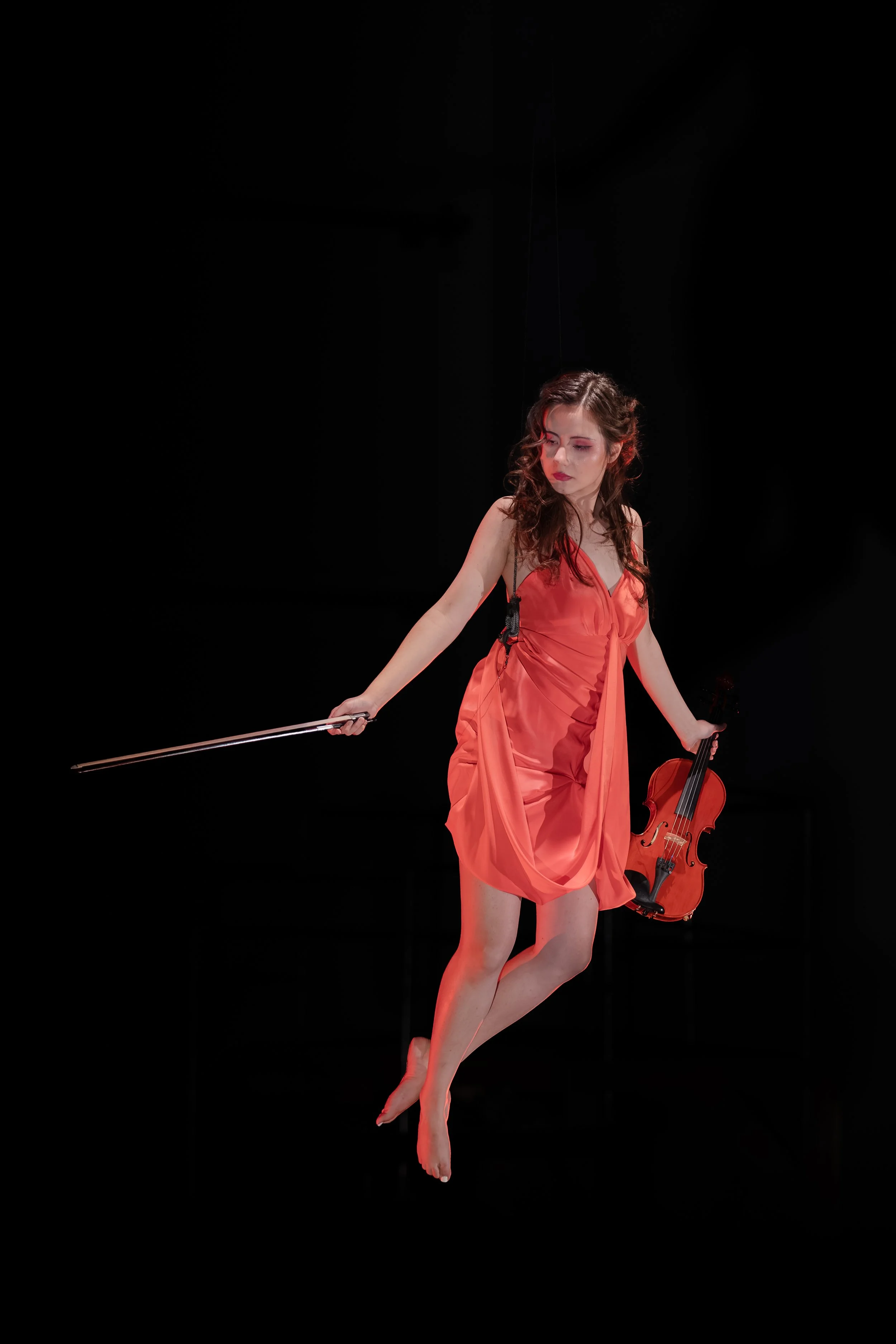
This past summer I had the opportunity to sit down with both Robbie Bui and Jordan Hadrill, the performers at the heart of my new film series. Robbie is the cellist featured in Moondial, the series' first work, and Jordan is the violinist featured in Sun Spring, the series' second work. Robbie led the discussion. The talk took place at the Bombyx Center for Arts and Equity in Florence, MA. This transcript has been edited for ease of reading and clarity.
ROBBIE:
So I guess first, maybe you could start by giving a little more context on the piece for anybody who has not seen the films.
JOHN:
Yes, absolutely. In the spring of 2024, I was sitting with my wife at a cafe in Spoleto, Italy, talking about new horizons and creative chapters we were both having. We were about to start a semester at the American Academy in Rome. So, it was a moment full of creative promise, but I wasn't sure how I wanted to take advantage of the time. During that talk, it occurred to me that if I ever wrote anything like a string quartet it would have to be quite a different kind of contribution to the genre. And so I asked myself, well, what could I contribute to the world of strings? It dawned on me to compose something that would feature the player confronting themselves. I thought about playing with mirror images and then playing with the idea of analog digital reflections. So, a few months after that, I started on Moondial as maybe even a conceptual etude while I was traveling away from Rome in Geneva, Switzerland. I started the work at an apartment rental overlooking Lake Geneva with a small upright piano in the living room. While I was working on Moondial, I thought that I might be able to create a few pieces in this line of thinking. I came to you Robbie and I remember saying, would you be interested in kind of indulging this as an experiment? And we thought it through a lot. We had a lot of conversations about what this would be like to try and match analog and digital presentations. And the entire artistic team on the project was great. Alex Posen did the costumes. Gyani Pradhan Sui was our cinematographer. So it's a great team of artists that came together to make this vision come to life. Then I started a piece for three violins and that's become another music film we can show at the end of this talk in addition to Moondial. And the violin piece was a collaboration I took up with Jordan.
ROBBIE:
There's a specific detail that I wanted to probe you about within the conceptual process of composing Moondial. From the beginning, you were talking about the reflection between the analog and the digital person. The original conception of Moondial was actually for a live player with video. And we talked a lot about needing a life size TV monitor. You bought that giant Walmart TV to film this on.
JOHN:
We did. We went to Walmart and got this immense monitor, like a 6 foot tall monitor.
ROBBIE:
Yeah, we worked with it. And I think that's a very distinct part of the piece. It's a different conception of the work than the film we are seeing now. The film features two videos in a mirrored form and so they're indistinguishable in terms of whether one is live and the other video. In the other version, I think the experience of the 'digital' versus the 'analog' human is much more explicit. Can you talk a little more about what your vision would be if we had the opportunity to do a live version with what I just described?
JOHN:
Absolutely. So one important aspect of these pieces is that they exist in many forms. There's an analog form to Moondial where two cellists perform it. Then, there is a film version that we are screening here today, which is a fully digital, filmic, presentation of the work. The concept that is perhaps the hardest to reproduce, and that has not yet been reproduced live, is a version of the piece that we prototyped where Robbie performs one of the parts live and the other part is reproduced on a monitor that appears to be a digital mirror image of Robbie's performance. So, in that version, a human being is playing along with the video but the video monitor is presented as a mirror. And this version kind of grew out of that initial concept I had of a player confronting a digital reflection of themselves. So, in this version, we would see the human and video mirror each other and at times wonder whether the human or the reflection is pulling away. There's a tension inherent in this musical / visual space between moments that are synchronized and asynchronized. This is something we worked on also in Jordan's video: this play of which character is dictating the pace. Which one is real and which one is the avatar? Which one is digital or are they both alive in different ways? What kind of spaces are they inhabiting?
ROBBIE:
Would you say that the parts are interchangeable?
JOHN:
Absolutely. They are interchangeable. And it would be an interesting choice for the performer to make [of which one to play] because both are video recorded. So either one could be cast. A cellist or a director could make the decision. I mean, we are talking about the construction of the piece and it's very interesting to think about the idea of the video, but I imagine that an audience [member] receiving the work might not be able to discern if the cellist and the video were presented in a completely pitch black stage. An image comes up, is that light on a human being, or a video? We might not know at first. I'm thinking of these works as trying to mask the digitization at times, nevertheless use it as a tool.
ROBBIE:
And what about a version where there are two live players. Say you found another cellist that looks similar to me or dressed the same way, could you explain a little more about how that might change the narrative experience for you?
JOHN:
Well, I think that if it were performed analog, I mean, I wonder if that's the right term to use, but performed by simply two cellists, I wouldn't even worry too much about the presentation. I think that then the music is entirely foregrounded and it becomes a piece for two cellos. And you're watching two people play cello and the cellos are mirroring each other. And there's certainly plenty of intrigue but I'm not sure that I would be too concerned. You know, you write a piece, you put it out in the world and people play it. So, I don't have too much need for myself about how people would perform the work, or the violin work for that matter. Jordan, what do you think?
JORDAN:
I think that it also depends a lot on how much of the piece for you is dependent on the rigging and the rotation [in the violin work]. But I don't think it would lose a lot because also, as I was playing it, I wanted it to be quite organic, and in some ways, you know, I was stretching the 32nd notes. And I think that if I had done it completely with the click track, very robotically, then maybe it would have suffered in having three live performers. But I think that the way we did it, where it's supposed to be something organic – and these characters are live, distinct, individual characters – was great. I think it would still make sense to perform it with three different people.
JOHN:
Robbie, what did you feel about the playing on the click track and the rigidity of that vs. the organicism that Jordan is talking about?
ROBBIE:
You actually led straight to a question that came up with this. As we were learning this, I was like, holy shit, John, this is fast. Because, when you click track something like that, there's no human to help pull [the tempo] back. I'm being forced to be pulled along by my 'digital past self' if you will. Do you think there's a consequence of surrendering that musicality? Is [the music] more robotic and more locked in to something that is not able to phrase? Or is that, you know, maybe even part of the intention?
JOHN:
Yeah, there's a tension there. In order to synchronize these videos you had to play along with click tracks. I think the idea that everything is synchronized is a construction feature. So that when I want things to look synchronized, they can be. And I think a cool feature of the piece is that you see things working very much in synch, and then, you are able to play with the players kind of pulling apart. It's a cool feature. But then, you kind of have to play against the click. In Jordan's piece, as the two violinists start playing , one plays triplets and the other plays 16th notes, so they purposefully play apart from each other and then slowly synch together. But yeah, I think it has to be a feature of the work. Otherwise, I think the work would feel stodgy.
ROBBIE:
Can you talk a little bit about the form of the piece that we just watched here and your choices of when to palace those moments of synchrony and asynchrony? And how that also drives the tension between the digital / analog ideas that you were discussing?
JOHN:
Well, yeah, I mean, it's funny, I was talking to, maybe it was Mindy (Melinda Wagner) about how I can't remember how I wrote any of my music! You know, I can't really remember everything that was going on in my mind when I wrote these pieces. But there are definitely aspects to mention. In Moondial, the two-note motto is very easy to synchronize. And so that became a feature that I used as a synchronous moment. And then, as the music starts to flow out and become more mellifluous, it becomes easier to feature asynchronicity and to have the musicians tear apart from each other. So, I think a a lot of the form of the piece is dictated by when I wanted the musical moments to align and when I wanted them to feel blurry. For example, the passages with the sound of harmonics and such, I thought, I like the way those turned out because there's a balance between the music sounding amorphous, but the players looking like they are synchronized. So, that was a nice way in which the video could feel synchronized and the audio could feel blurry. And then, of course, there's many moments when you see everything synching up, which I like. So yeah, I think the form became something about trying to manage that tension.
ROBBIE:
That's really great. Should we show the other piece and then take questions?
JOHN:
Ok, so this is a rough cut and not a finished product. This just happened and we just got the video back and there's still some audio to do and some other synchronization we need to do. But that's all I'll say.
[Screening of rough cut to Genesis]
ROBBIE:
Wow. My first question is, why was I not invited to also fly in space?! Wow, this does bring up a lot of questions. I don't even know where to start but I guess, can you talk more about your idea of musical narrative and how this contrasts across the three different characters? The three different Jordan's here.
JOHN:
Yeah, bringing in a third character was a challenge, and it made me think about wanting to do different things with the narrative. And you can see that the outer characters are still flipped, so there's still a mirror image from the left to right. That made me think that there needed to be some kind of drama between the outer characters and something in the middle, and so that freed up a lot of narrative possibilities about making the middle character very responsive. And in my mind [the middle character is a] more asynchronous and fluid character than the outer characters. I tried to think about synchronizing the outer characters with rotations so that they would come in and out of contact with each other across clock dial rotations. Then as the outer characters rotate more, the inner character plays more vertically.
ROBBIE:
Yeah, can you talk more about those musical gestures, especially during those key theatrical moments, when Jordan is in air and especially when there's entrances and exits of the characters?
JOHN:
Well, one of the things that drove my thinking around Moondial is the idea that the piece is a ritual. I'm interested in creating pieces that feel like they're ritualistic in some way. So, I definitely feel that in Moondial, that there's a kind of ritual – witnessing a ritual – happening. And I'm trying to create a mood, not necessarily somber or anything, but kind of, you know, more meditative and spiritual in some sense. And I definitely feel that about Sun Spring as well. The choreography is about some kind of ritual unfolding. And the music is something that enlivens the ritual or makes the ritual sound or brings it to life. Because it has to be music. As if music is needed in order to complete the ritual. For example, I think that in the beginning of Sun Spring, the two outer characters have to play their music in order to kind of enchant or awaken whatever kind of choreography is happening in the middle character. So, I think that's kind of how I'm thinking about the gestures and the choreography and the entrances and exits.
ROBBIE:
I'm getting the sense of why it was important for me to be duplicated in Moondial because you're talking a lot about these mirror reflections of each other, but I'm sensing a much more complex narrative in a more complex form and interplay between these three very quite distinct characters in Genesis. Can you explain why you decided on three duplicates in this work rather than two?
JOHN:
Well, partly I just wanted to challenge myself to do something different. And in so working with three, having to conceive of new relationships. And so, maybe the piece is less confrontational than Moondial in some sense. What's interesting to me about Moondial is how stark the relationships are. What's interesting to me about Genesis is that the characters seem to now be developing some kind of autonomy they didn't have in Moondial. Which makes their relationships more layered. (To Jordan): I'm curious about what you thought about inhabiting these characters.
JORDAN:
I think that in learning it there was definitely a very strong sense that the outer two characters are much more related and that the inner character was kind of her own thing. I quickly picked up the mannerisms of the outer characters. It's something we talked a lot about – how I should act and be looking at my other selves. But I do strongly sense that there is an interplay with all of them and I do feel that they all kind of exist in the same universe and they play off each other. And while the two outer characters have the same roles in this piece, their roles in the music are also very similar. They have similar figures at the same time. So it feels like rather than having three characters that are completely distinct from each other you have these two characters who are like the same type of creature and this third character who will maybe become this creature in the future but for now is shaping itself organically and learning from those around it.
ROBBIE:
Did Alex also work on the costumes?
JOHN:
Yes, same team. And JoAnna [Pope], who's directing Etchings this week, helped with wardrobe. We brought in Ashe [Parker[ for hair and make up and Sean [Ryan[ constructed the platform and worked the choreography of the platform.
ROBBIE:
Regarding the costume, as you know for me I was dressed as a non-binary alien! And for Jordan, I'm curious about what Alex was thinking for her costume as well.
JOHN:
With both pieces I worked a lot with Alex [Posen] on the costume and talked a lot with her about the concepts as she was designing them. For the trio, we talked a lot about wanting a Renaissance color palette. One of the concepts that's shot through both pieces is the connection of the instrument to the body and the idea of the origins of these instruments being in older European models of the Renaissance which was also a time when early clocks and watches were being developed. The synchrony in both pieces reminds me a lot of old watches. I've always been fascinated with the astronomical clock at the cathedral in Strasbourg. That has been an inspiration for the entire series.
ROBBIE:
And so in Moondial, we rehearsed my walk-on with exact pacing, how I should look, my demeanor, the exact timing. I'm curious for both of you, what kinds of theatrical subtleties did you rehearse for Sun Spring?
JORDAN:
We talked a lot about having two sentry characters. We also practiced the walk on a lot! I think that in terms of choreography something that we rehearsed the most was the actual lifting and unfurling. So, initially John asked me, can you rotate in the air, and I was like, no! Because I'm not that skilled. So [the aerial arts team] hooked me up to a fishing wire that came off my aerial harness and it was operated by a professional kite spooler – I didn't know those existed! And so [Margaret Butterfield] what running around in circles during the shoot to help me rotate. Thank you Margaret! I think the most interesting part of the choreography for me was the unfurling as I was lifting. And also just trying to look natural when I was in the air. If I'm not activating my entire body I'll just look like I'm just dangling. So throughout the whole thing I think, Henry [Wheaton] who was running the aerial arts crew, taught me how to engage my core so that I could tense and relax parts of my body so that I would look like I was organically floating instead of being hoisted in the air. That part is where we spent the most energy in terms of body control.
JOHN:
Yeah, we had a lot of lessons with Henry Wheaton, an amazing aerial artist.
ROBBIE:
I think we're out of time.
JOHN:
Before we go I just want to say thanks to you both for being the central part of these collaborations. It has been so special to work with you both. These pieces are definitely collaborative and I wouldn't have been able to create them without all the conversations with you both and your willingness to be so generous with your thoughts and creativity. Thank you!
JORDAN:
Thank you. It's been a great experience.
ROBBIE:
Thank you both!