Oblivion
Opera in One Act
John Aylward's chamber opera Oblivion tackles questions of memory, self-knowledge, and meaning through its rich, colorful score for four voices, viola, cello, double bass, electric guitar, and electronics. Inspired by the writings of Dante and Joseph Campbell, Aylward grapples with self-inquiry, crafting a fantastical tale that prompts timeless existential conundrums that we all face.
-
I. Prologue 4:13
II. Scene 1 6:29
III. Scene 2 8:21
IV. Scene 3 6:05
V. Scene 4 12:48
VI. Scene 5 & Interlude 12:19
VII. Scene 6 14:20
-
Recorded at the Bombyx Center for Arts and Equity, Florence, Massachusetts, June 25th–30th, 2022
Produced by John Aylward
Joel Gordon, recording engineer
Peter Atkinson, recording assistant
Edited, mixed and mastered by Joel Gordon and John AylwardDesign, layout & typography: Marc Wolf, marcjwolf.com
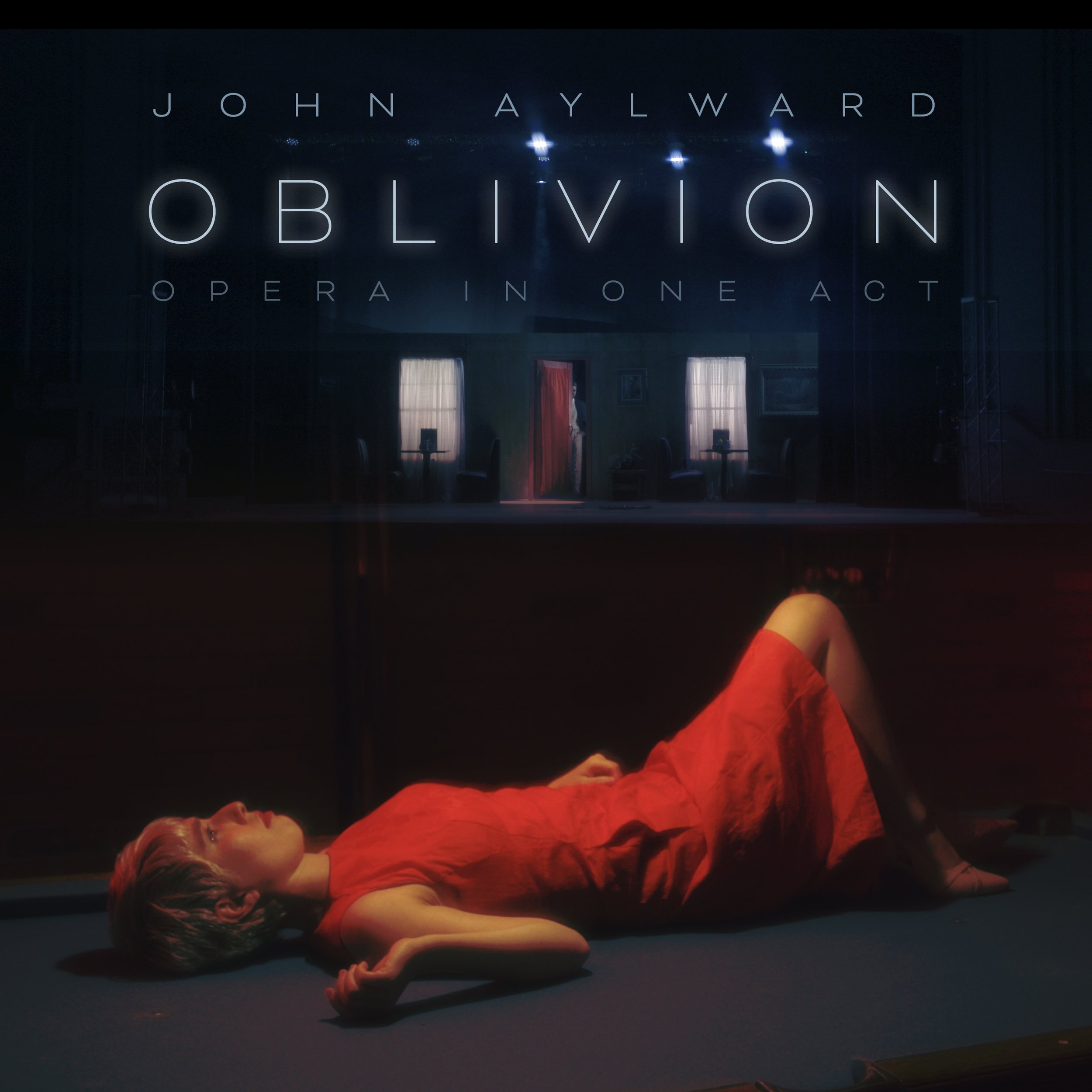
Cover Image: Composite of stills from the August 2022 film production: Top image: Stage set; Bottom image: Nina Guo -
Nina Guo, soprano
Lukas Papenfusscline, tenor
Tyler Boque, baritone
Cailin Marcel Manson, baritone
Laura Williamson, viola
Issei Herr, cello
Greg Chudzik, contrabass
Daniel Lippel, electric guitar
John Aylward, electronics
Tianyi Wang, electronic sound design assistant
Stratis Minakakis, music director & conductor
-
John Aylward’s chamber opera Oblivion is a haunting exploration of memory, destiny, and self‑knowledge. Loosely inspired by Dante’s Purgatory and enriched by myth and philosophy, the work follows two Wanderers through a surreal landscape where truth and illusion blur. Along the way, they encounter an enigmatic Hunter, a Bound Man who transforms into a King, and a series of trials that force them to confront the nature of deception, salvation, and self‑understanding.
Scored for voices, strings, electric guitar, and electronics, Aylward’s music is beguiling and mysterious, grounded in a harmonic language influenced by Messiaen and Dutilleux. Low‑register timbres, spectral harmonies, and atmospheric electronics create a sound world that feels both intimate and otherworldly. Woozy glissandi, angular vocal lines, and virtuosic contrabass writing heighten the drama, while stripped‑down duos between voice and instrument offer moments of piercing clarity.
The opera builds from foreboding windscapes to dense, climactic confrontations, culminating in an ambiguous finale that leaves listeners questioning whether salvation is genuine or illusory. As the fog lifts and the opening windscape returns, Oblivion lingers as a meditation on how we discern truth in a world clouded by circumstance. Aylward’s opera invites us into a journey of wonder, pathos, and unanswerable questions.