Celestial Forms and Stories
Performed by Klangforum Wien
Inspired by Ovid's Metamorphoses and Calvino's deconstructive analysis of the classic Roman recasting of Greek myths, John Aylward's Celestial Forms and Stories establishes musical analogs to Ovid's way of depicting the world. Featuring musicians from Klangforum Wien in chamber formations, Celestial Forms and Stories encapsulates the transformative nature of myth, constantly being reimagined and reinterpreted over generations and retellings.
-
I. Daedalus 9:40
II. Mercury 8:43
III. Ephemera 8:55
IV. Narcissus 11:32
V. Ananke 15:11
-
Recording Engineers: Kristaps Auster & Christoph Walder
Editing, mixing & mastering: Joel Gordon
Recorded at Tonzauber Recording Studio in Wiener Konzerthaus, Vienna, Austria, November 28th, 29th and 30th, 2020
Design: Marc Wolf, marcjwolf.com
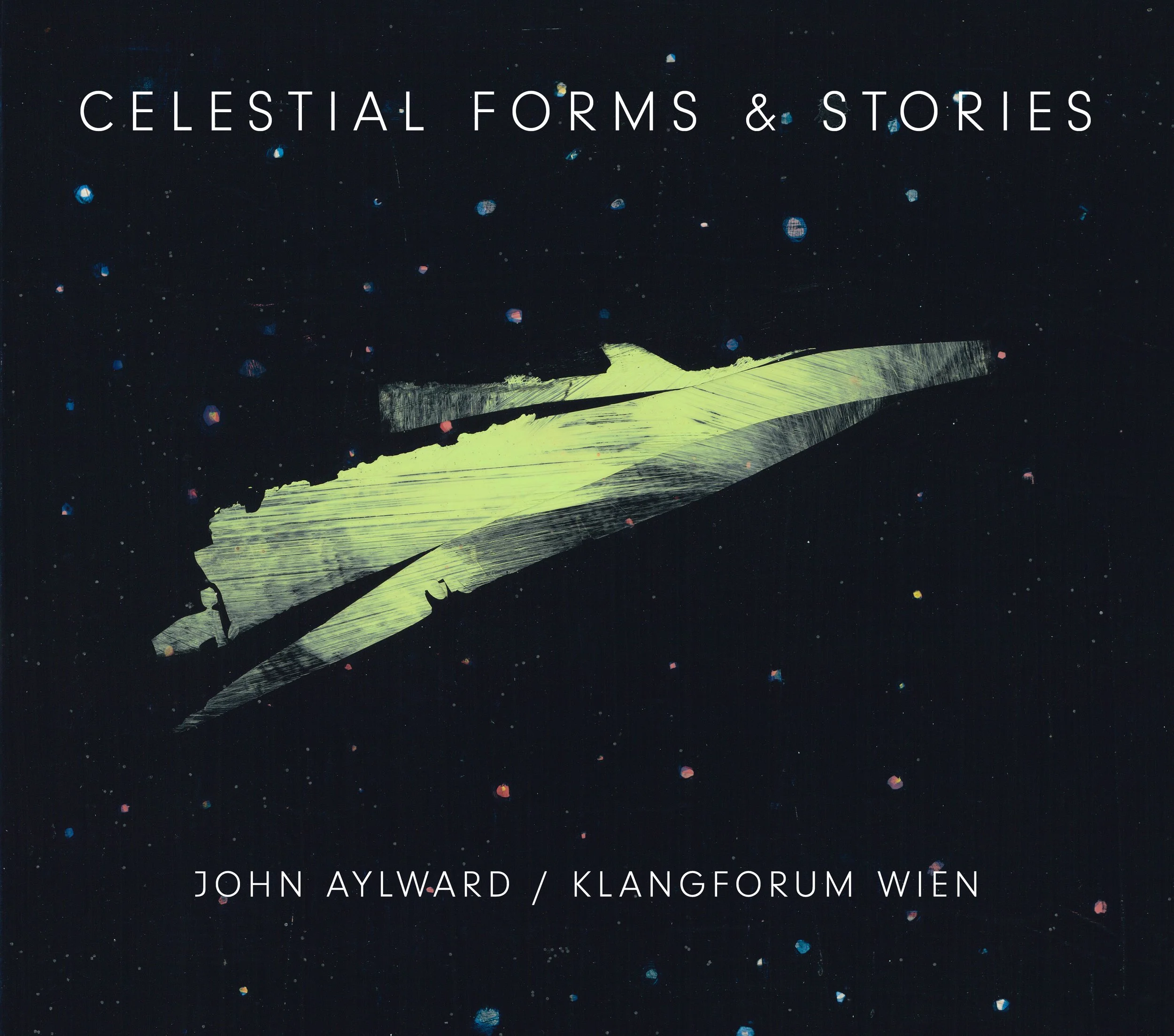
Cover Image: Aylward, Roberta. Nightlight. 2015
Acrylic on birch panel. In the collection of the artist
Back cover image: Aylward, Roberta. Flare. 2015. Acrylic on birch panel. In the collection of the artist
John Aylward photo: Kate Soper
Klangforum member photographs: Tina Herzl
Finnegan Downie Dear photo: Frank Bloedhorn
-
Klangforum Wien
Bernhard Zachhuber, clarinet & bass clarinet
Olivier Vivarès, clarinet & bass clarinet
Sophie Schafleitner, violin
Dimitrios Polisoidis, viola
Andreas Lindenbaum, cello
Markus Deuter, oboe
Florian Müller, piano,
Björn Wilker, percussion
Finnegan Downie Dear, conductor
-
John Aylward’s Celestial Forms and Stories is a musical exploration of myth filtered through literary analysis. Rather than depicting Greek figures like Narcissus or Mercury directly, Aylward engages with Italo Calvino’s study of Ovid’s Metamorphoses, focusing on Ovid’s tendency to explain phenomena through “elementary properties.” The result is not a retelling of myths but a reanimation, probing how stories evolve across generations and remain alive through reinterpretation.
The album, performed by Klangforum Wien, opens with Daedalus and Mercury for quartet. Distinct characters emerge immediately: anxious flute gestures, elastic violin glissandi, and sustained pitches that later expand into extended passages. Mercury revels in instability, with fragile string harmonics and shifting wind lines that highlight unpredictability. Ephemera, the earliest work, sets clarinet bursts against cello tremolo, growing into ecstatic dialogue that intensifies with momentum.
The final works, Narcissus and Ananke, are scored for septet. In Narcissus, imitation drives the texture as voices interrupt and enclose one another. Ananke obsessively examines gestures from multiple angles, colored by Aylward’s polychromatic palette. Stravinsky‑like chords, oscillating low figures, and a dramatic piano solo culminate in a repeated viola figure that closes the album with ambiguity.
This unresolved ending underscores Aylward’s vision: myths are living organisms, continually reshaped by analysis and imagination, and his music situates itself within that ongoing lineage.