MOONBEAM
2014. 9’
For soprano soloist, 2 flutes, 1 alto flute, 1 oboe, 2 clarinets (one doubling bass clarinet), 1 bassoon, 2 Horns in F, 2 C trumpets, 1 trombone, 1 percussionist, harp, piano/celeste, and strings.
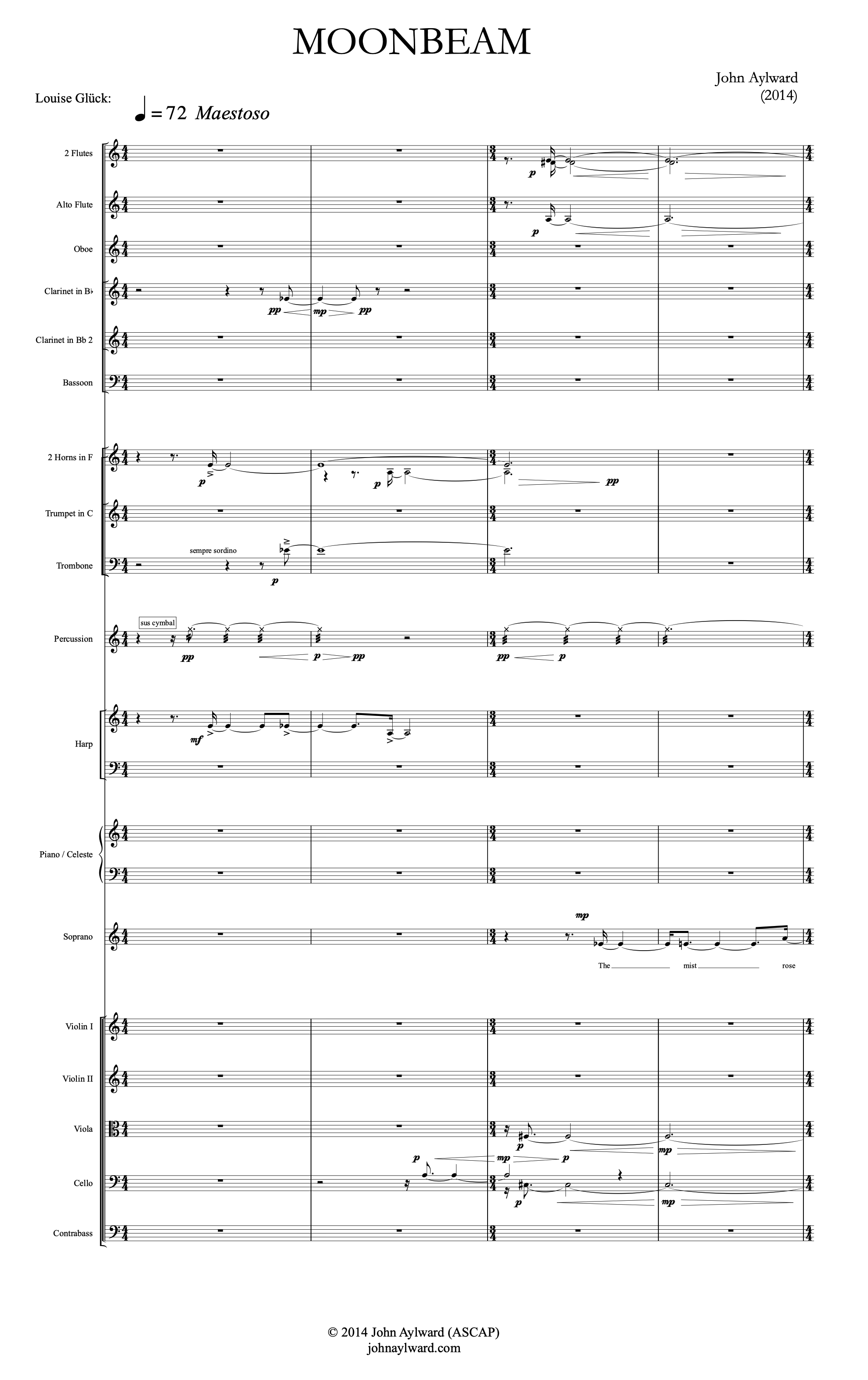
After setting Songs from the Wild Iris, I was left with one more poem by Louis Glück that I wanted to set: Moonbeam. This poem, from The Seven Ages, is in turn inspired by a poem by Giacomo Leopardi.
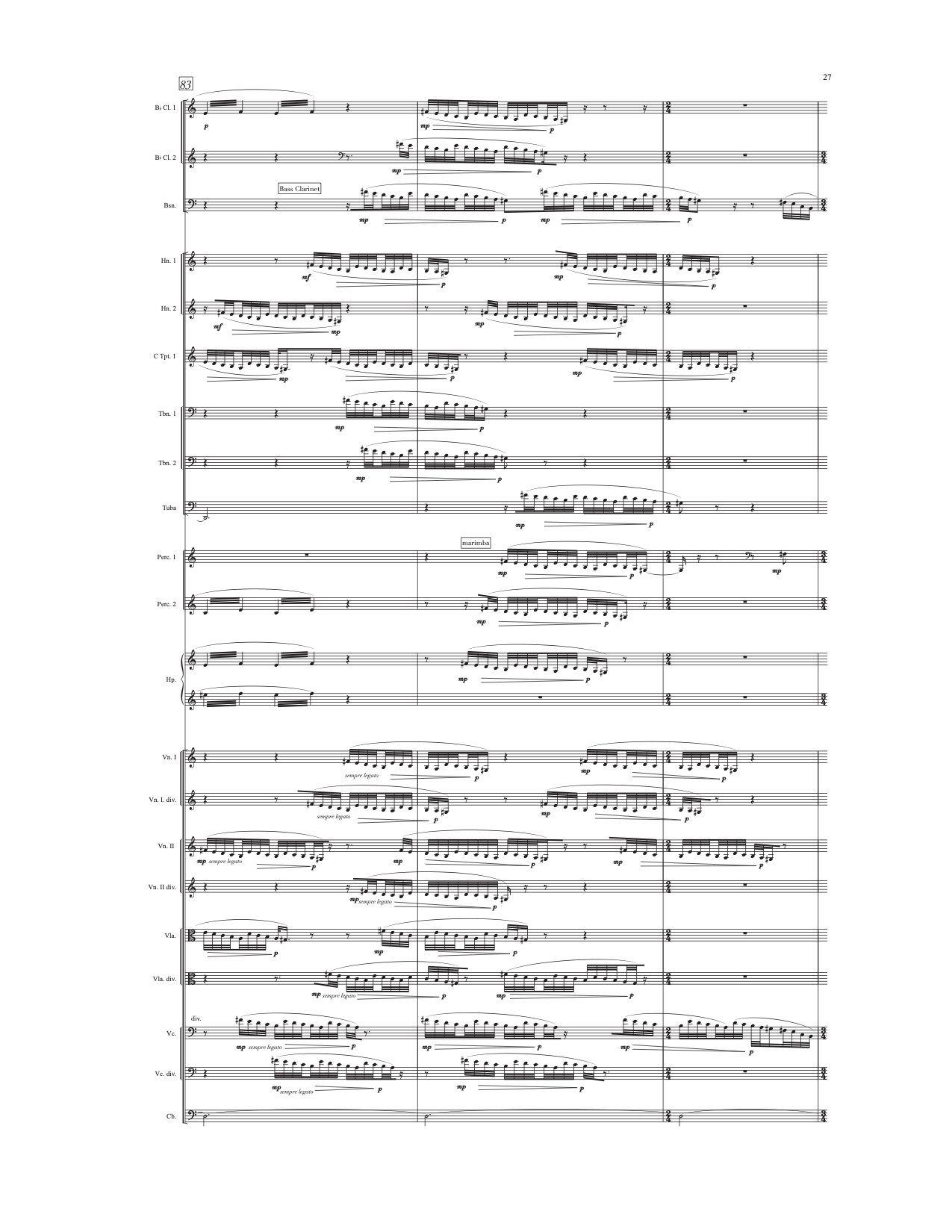
I include an excerpt from the score here, and the Leopardi poem, both in the original Italian and translated. Though my setting is of the Glück, I would like to think that the Leopardi poem is also somehow present in the music.
DI UN PASTORE ERRANTE DELL’ASIA
Che fai tu, luna, in ciel? Dimmi, che fai,silenziosa luna?
Sorgi la sera, e vai,
contemplando i deserti; indi ti posi.
Ancor non sei tu paga
di riandare i sempiterni calli?
Ancor non prendi a schivo, ancor sei vaga
di mirar queste valli?
Somiglia alla tua vita
la vita del pastore.
Sorge in sul primo albore
move la greggia oltre pel campo, e vede
greggi, fontane ed erbe;
poi stanco si riposa in su la sera:
altro mai non ispera.
Dimmi, o luna: a che vale
al pastor la sua vita,
la vostra vita a voi? d
il tuo corso immortale?
--Giacomo Leopardi
NIGHT SONG OF A WANDERING SHEPHERD OF ASIA
Why are you there, moon, in the sky? Tell me,
Silent moon, why are you there?
You rise at eventide, and go
To contemplate deserted places; and then you set.
Have you not yet had enough
Of traveling these everlasting ways?
Are you not tired of it, or are you still content
To gaze down on these valleys?
A shepherd’s life
Is like the life you live.
He rises at first light,
And leads his flock across the fields. He sees
The flocks, the streams, the grass.
Then tired out, he takes his rest as evening falls.
He hopes for nothing more.
Moon, tell me what worth
The shepherd’s life is to him
Or yours to you? Tell me: where
Does my brief wandering lead
Or your immortal course?
ETERNAL RETURN
2023. 20′.
for 2 flutes (1 doubling piccolo), 2 oboes, 2 clarinets (one doubling bass clarinet), 2 bassoon, 2 Horns in F, 2 C trumpets, 2 trombones, tuba, 2 percussionists, harp, piano/celeste, and strings.
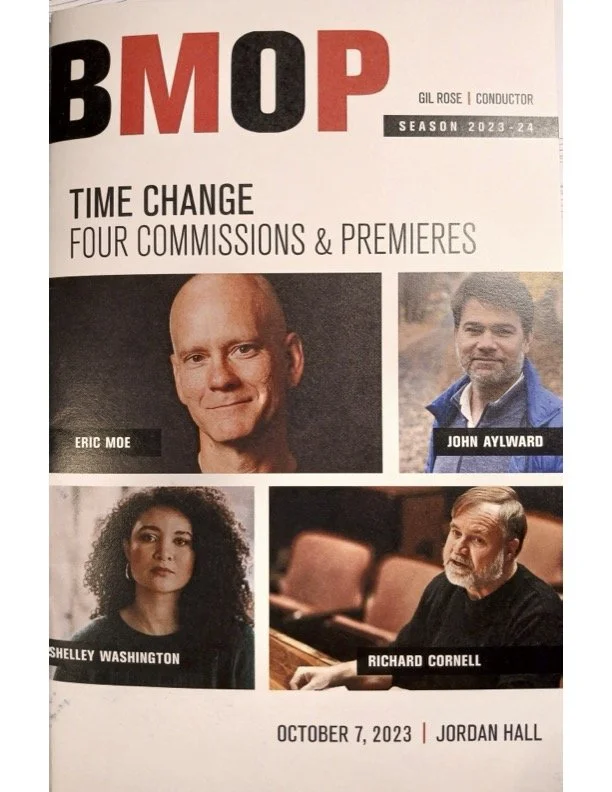
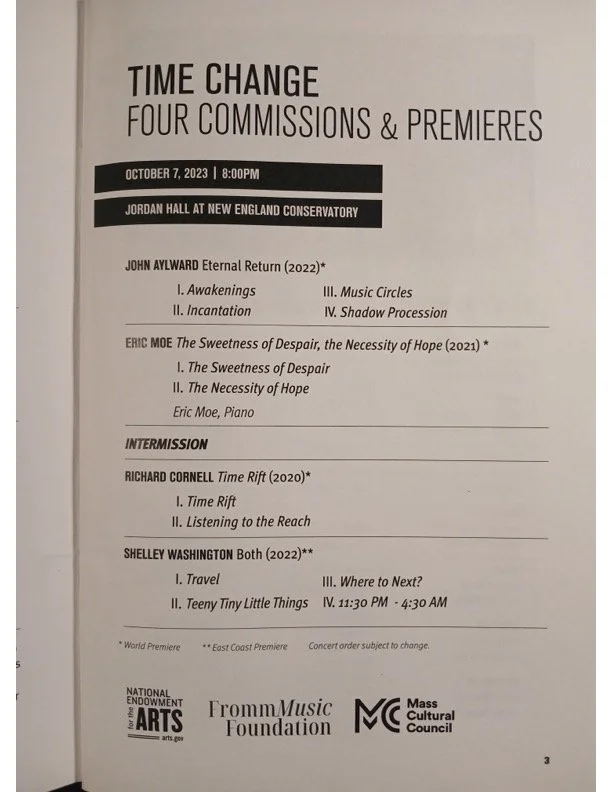
Premiere: Boston Modern Orchestra. Gil Rose, conductor.
October 11, 2023.
Jordan Hall. New England Conservatory. Boston, MA.
“…glides with scorrevole fluency but is never lacking in its variation…”
“While the philosophical idea of eternal return may have originated with the Pythagoreans, Stoicism would later latch onto and further elaborate upon this idea that the universe is destroyed by cataclysm (ekpyrosis or enúpwo) only to be reborn (palingenesis or naiyyeveoia) in an endlessly returning loop. In the aftermath of the COVID-19 pandemic, this sense of death and rebirth takes on new meaning as the music community begins to reevaluate and rebuild after immense and widespread hardship.
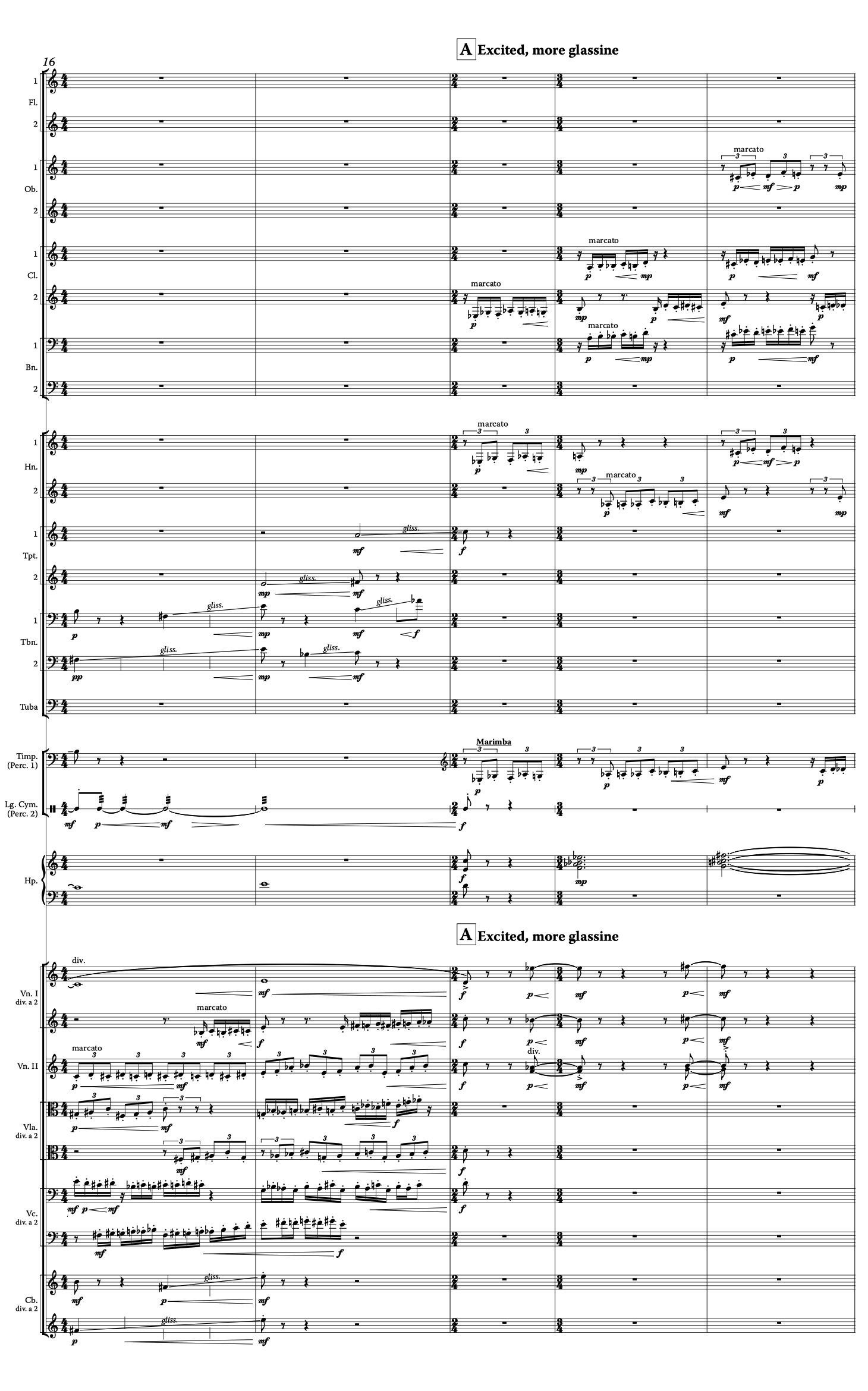
The first movement, Awakening, begins abruptly, almost as if starting from a fevered dream in a frantic state or as if acclimating to an overwhelming epiphany or realization about reality. Clouds of sound from the collections of instruments, always in the act of gathering and dispersing, make up the drama of the music here. Clusters of notes and figures accumulate, growing into dense timbral thickets, sometimes suddenly leading into clearings of sparse pointillism or suspension. Marked "fast, insistent" in the score, descending scalar passages by winds and violins ride atop waves of swelling brass and low strings. Skittering and nervous, eventually militaristic-like percussion calls the rest of the orchestra to attention as brass instruments are added into the mix.
Giving up their supportive role, low strings cannot help but join in on the incessant downward marching motifs as well, continuing until they are left alone to exhaust themselves as pointedly impressionistic gestures from the harp signal and foreshadow the next movement.
Incantation begins in a more solemn and mysterious way. Rising-and-falling arpeggios are passed between clarinet and harp in a conversationally antiphonal manner, making up an active foreground that dramatically juxtaposes the more static, non-vibrato swathes of sound from high winds and strings. As in the first movement, the strings are again lured into the action, adding a more brooding and nervous tone to the proceedings. They are soon followed by the winds, as well. However, the texture of the music becomes more fragile as the winds transition into more punctuated gestures of impressionistic aplomb, marked as "diaphanous, still somewhat excited." Disjointed textures, created by a compositional technique called hocket where instruments intermesh in a holistic way to make up and complete more fully fleshed-out textures, slowly fade away to make room for a burgeoning unison of tutti strings as the music becomes heavier and approaches another boundary-marking stillness.
The third movement, entitled Mystic Circles, starts in a more wistful way, contrasting a meandering duet of clarinets with playful pointillistic percussion writing. The duet's entwined writhing rouses other instruments to their cause, inevitably building from the music's accretion; but the music climbs in register only to fall back down again shortly thereafter, thereby creating a music analogous to a circle where the beginning is the end is the beginning, so to speak. Such a music of circular "eternal returns" is inherently restless, slowly undulating back and forth between states. Indeed, this process also continues throughout the fourth movement, Shadow Procession - a reference to South African artist William Kentridge's short film of silhouetted animation of the same name. (Both notably draw upon Plato's Allegory of the Cave as inspiration.) Here at the finale, Aylward crafts a music that flows and glides with scorrevole fluency but is never lacking in its variation while doing so. Excited and motoric textures may become more tranquil yet will show no signs of slowing, pressing forward into suddenly broader vistas of musical landscape. At last, a return to the first movement's nervous and skittering tone is juxtaposed with a languid legato whose increased smoothness only seems to facilitate and lubricate the rapid-fire runs that rush the music into its final moments.”
-Clifton Ingram, writing for BMOP
HISTORY OF THE WORLD
2025. 30′.
for 2 flutes (1 doubling piccolo), 2 oboes, 2 clarinets (one doubling bass clarinet), 2 bassoon, 2 Horns in F, 2 C trumpets, 2 trombones, tuba,
2 percussionists, harp, piano/celeste, and strings.
I. The Birth of David
II. Distant Messanger
III. Garden of Eden
Premiere: Boston Modern Orchestra. Gil Rose, conductor. April 19, 2025.
Jordan Hall. New England Conservatory. Boston, MA.
In History of the World, I set out to compose three inter-related works that deal with the shared histories of our past and the possibilities of our undiscovered future. To root these explorations, I look to Michelangelo and Galileo, whose lives spanned a unique period of humanity where older mythologies were being reimagined and scientific developments offered pathways toward what I'm sure these thinkers hoped would be a shared future.
My work's outer movements deal with Michelangelo's reckonings of the old testament. His monumental depiction of David and his otherworldly rendering of Adam and Eve in the Garden of Eden imagine the mythological people as both unobtainable states and somehow entirely human. Galileo's perceptions and divine musings in Starry Messenger serve as the work's contemplative inner movement.
For me, it was important to have a work, so concerned with Western mythologies, be centered in our history’s nascent scientific developments. Today, new dangers in our social fabric have emerged as some are set on cultural erasure, afraid of both the liberations of scientific advancement and of mythological reinvention. Perhaps now more than ever this is a time to confirm a complicated and fraught history of the world shared by us all and owned by no one.
TRANSLUCENT WINDOWS
2012. 12′
Commissioned by the Boston Conservatory.
3 flutes (1 doubling piccolo), 2 clarinets, oboe,
alto saxophone, baritone saxophone, bassoon,
2 French horns, 2 trumpets, 2 trombones, tuba, 2 percussionists
I. Augury
II. Divination
The idea of architecture as a metaphor, and certainly a conduit, for psychological states is something explored in much great literature. The channeling of these states, for example in Calvino’s Invisible Cities, brings to my mind the idea of a translucent window: at once a metaphor for the veil or mask, and for the pursuit toward clarity of something outward, something beyond. Perhaps a more specific example is that of stained glass, used to illuminate religious allegory and myth.
The work’s first movement is an exploration of murmurs and soft textures,
punctuated with bursts of clear and sparse moments. Its title, Auguries, refers to an evocation of a cloud through which one can infer shapes and grasp at moments of clarity. The second movement presents a longer line through many instruments, accompanied by some of the same textures from the first movement. It’s title, Divination, suggests a kind of more active searching, as if the lines are imbued with more momentum and agency.